
Catalog / Daniel S. Alcorn
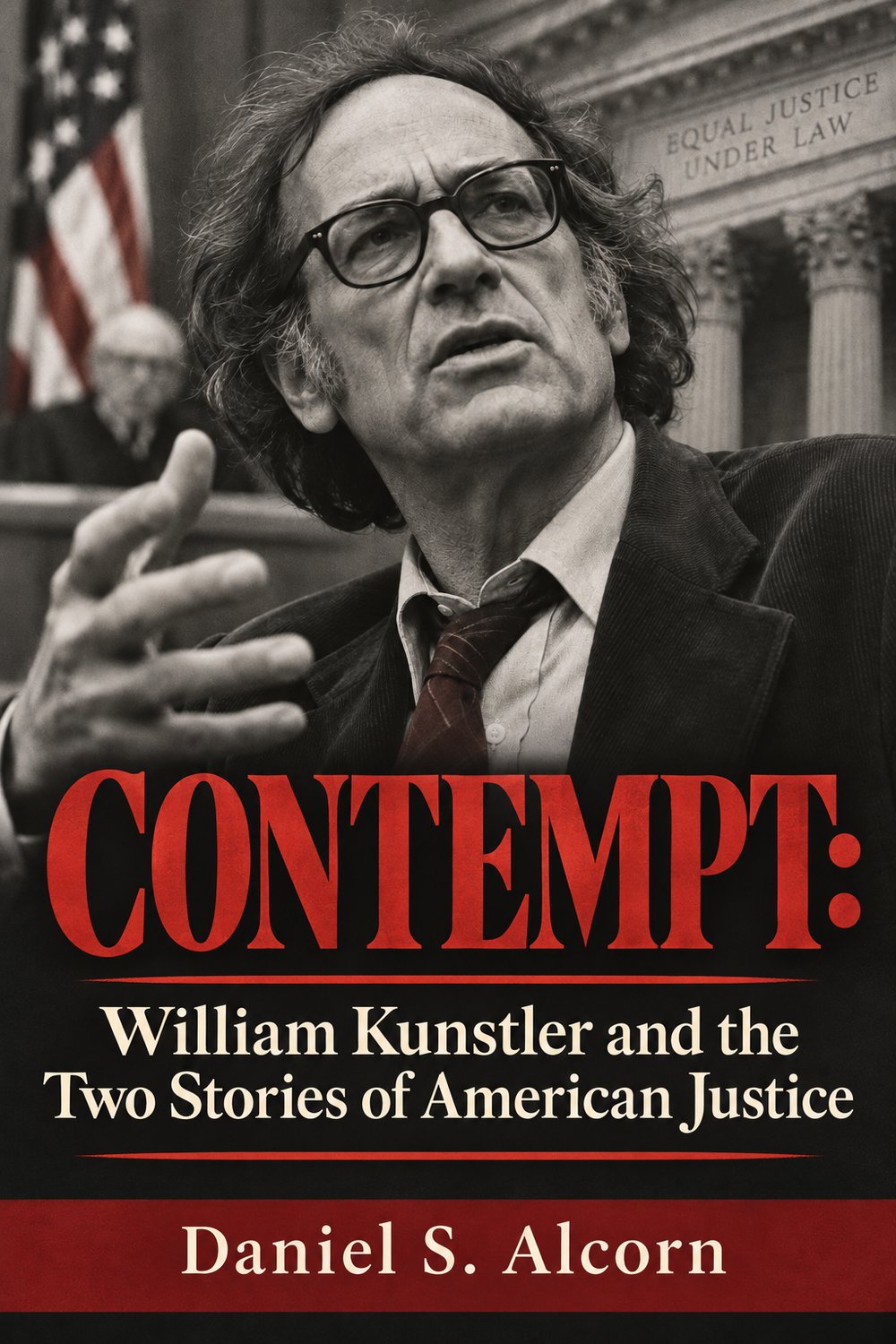
Contempt: William Kunstler and the Two Stories of American Justice
Forthcoming from Sterling Letter Press.
In February 1970, when the Chicago Seven trial ended, two portraits of William Kunstler were written within weeks of each other. In the courtroom, Judge Julius Hoffman sentenced him to more than four years for contempt and cast him as a lawyer who stood “in the wings” of American disorder and urged it on. In Washington, the FBI put him on its list of Americans to be detained in a national emergency, part of a file it kept for nearly two decades without ever once interviewing him. Kunstler wrote a third portrait himself, in memoirs, speeches and closing arguments, as the privileged man punished for his principles and unashamed of his tears. Contempt sets all three stories against the record of transcripts, court rulings, government documents and other people’s memories. It follows how an unremarkable Yale graduate, Army veteran and suburban practitioner turned, after 1960, into the most famous and most hated defense lawyer in America.
The book follows Kunstler from the Freedom Rides in Mississippi through the Catonsville Nine, Chicago, the Attica uprising and Wounded Knee, and on to the flag-burning cases and the Central Park jogger case of his final years. Again and again, the record comes down on his side about the government. The convictions in Chicago were overturned, Attica’s official account proved false, the Wounded Knee prosecutions collapsed over government misconduct, and the FBI’s portrait of him as an agitator didn’t hold up. But the record is harder on Kunstler himself. It shows a man who rarely invented events but constantly rearranged them to make a better story. It shows reckless words spoken from stages, and clients such as El Sayyid Nosair and Colin Ferguson whose cases his admirers would rather forget. And it shows how seldom he spoke of the victims on the other side.
The book was written by a lawyer who grew up in Oakland watching Kunstler on the evening news and counted him as a childhood hero. It neither defends the legend nor tears it down. It treats Kunstler the way a good lawyer treats any witness, however sympathetic, by testing his account against the evidence. What comes out is a portrait of a performer who believed in his cause and in himself, and who spent thirty-five years standing beside people the state had set itself against. Contempt concludes that he was right about the government more often than he was right about himself, and that for a lawyer, that is the better of the two ways to be wrong.
Also by Daniel S. Alcorn
- Schrödinger's Market
- Jurist: Verdict Without Mercy
- The Chicken Thieves of Watertown
- On Cruelty and the Law
- The Conditional Supremacy Clause
- Maturity
- Defensive Character
- The Jury and the Machine: Artificial Intelligence and the Limits of Algorithmic Adjudication
- November at Full Draw: An Illinois Bowhunting Story